DIABLO MOUNTAIN BIKING HISTORY
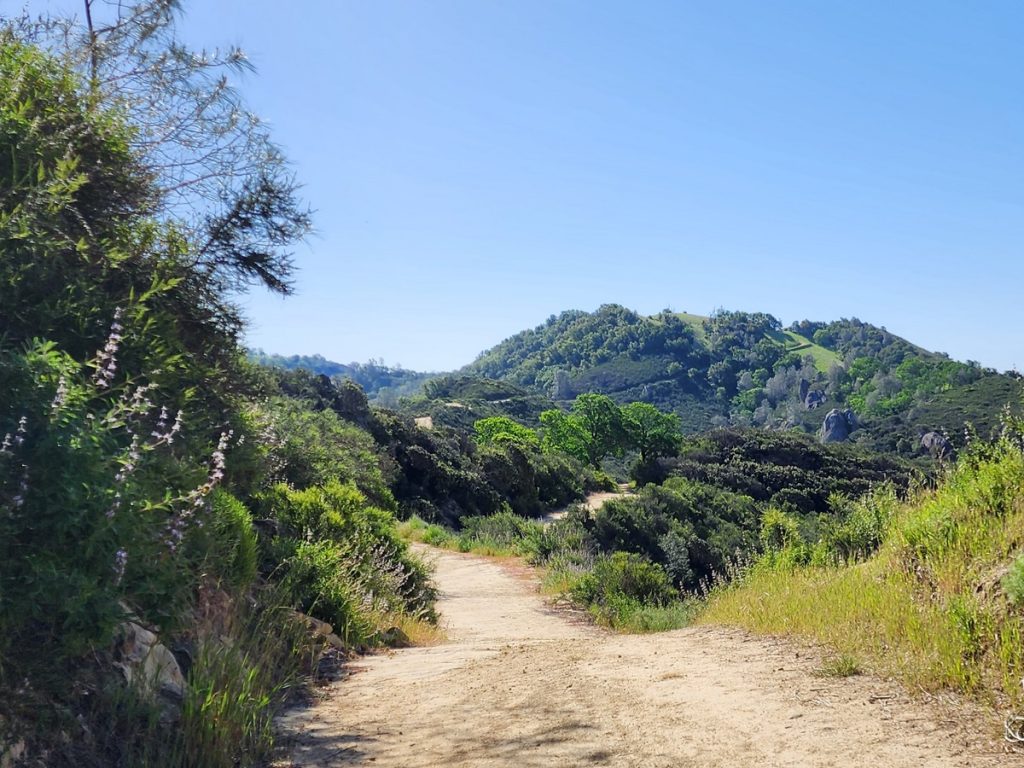
Mountain biking as we know it today is really an offshoot of the creativity of cyclists who did not want to be limited to paved roads. You show me a mountain (Mount Tam or Mount Diablo come to mind) with paved and dirt trails and varied terrain and I will show you early cyclists who tinkered with and stripped-down road bikes or reworked frames to create more durable bikes. The 1970s Clunker Era.
1978 is generally quoted as the beginning of the mountain bike market because by then some bike manufacturers were beginning to address the demand for off-road biking. But pockets of cyclists in many areas were already pushing the market through their own customizations. How else does a new sport emerge? In the case of mountain biking, it exploded.
First, let’s look at the transition. The cycling sport of cyclocross helped in the transition to full-fledged mountain biking. Cyclocross is literally a form of cycling cross-training. Road cyclists needing to stay in shape offseason and work on skills or just to looking to have some fun took to riding “off-road” and testing one another with obstacles and crazy terrain.
Cyclocross is a timed race of multiple laps held on a predefined short course (1-2 miles) with purposeful terrain challenges like stream crossings, rock and downed tree obstacles or steep terrain, requiring bikes to be carried or pushed and mud, lots of mud. And did I say poison oak. While it is all in good fun, bikes and bodies take a beating. Bikes were often custom built or created for the demands of the sport. Light weight but durable with narrower tires than today’s mountain bikes, more like the gravel bikes of today.
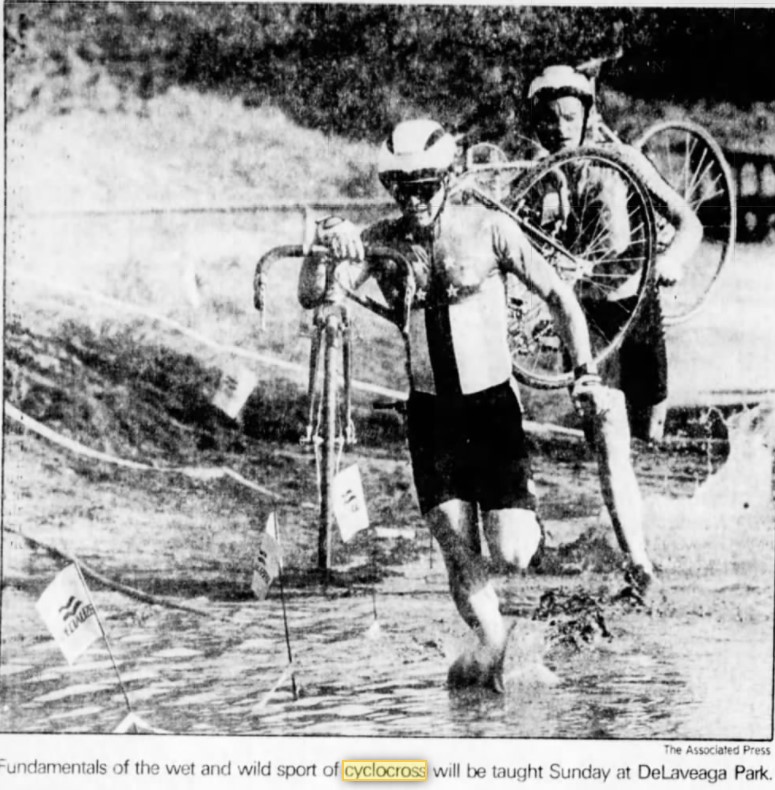
The first national championship of Cyclocross was held in 1963 in Illinois, continuing as a Midwest located championship until 1969 and then it exploded across the country. It became popular in Berkeley and Santa Cruz throughout the 70s and 80s, events being held in Tilden Park, Nisene Marks, Henry Cowell, many locations familiar to today’s mountain bikers.
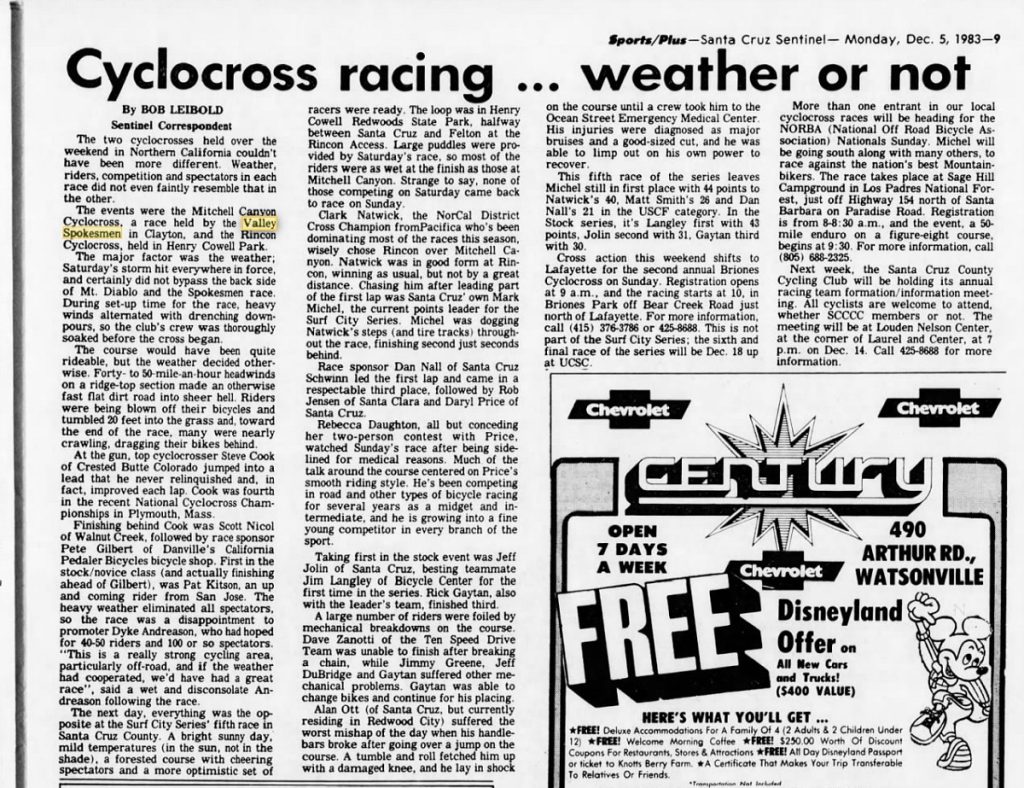
Since this article is about Mount Diablo, did you know that Mount Diablo held the Mitchell Canyon Cyclocross event in December 1983?
Mount Diablo 1983 Cyclocross Event
The Santa Cruz Sentinel reports that drenching rains coupled with heavy winds literally blew some riders off their bikes and near the end of the race many riders were crawling and dragging their bikes to the finish line. A top cyclocross rider from crested Butte Colorado Steve Cook won the race with Scott Nicol from Walnut Creek second and Pete Gilbert of Danville’s California Pedaler bicycle shop, the race sponsor, was third. Scott as many of you know, went on to start Ibis Cyclery and Pete Gilbert was a household name in the Danville area as a cyclist, racer, and as a major organizer, along with the Valley Spokesmen of the Mount Diablo Challenge annual race to the summit.
Because in the earliest days the line between road cyclists and mountain bikers was a narrow one, mountain biking really came into its own in the 1980s and beyond. But first a little history to set the stage.
EBATC Trail Advocacy
In 1970 a new organization was formed in the East Bay called the East Bay Area Trails Council (EBATC). The by-laws stated three purposes:
to provide an areawide basis for collaboration and liaison for all groups, bodies or entities, involved in the planning, funding, acquisition, development, maintenance and use of trails
to further the use and development of trails and to espouse legislation to this end locally, statewide, and nationally
to further the protection of the scenic and recreational resources of the East Bay Area for public use and enjoyment.
The footer in official letters from the organization said “The EBATC is composed of 10 public agencies who have the primary responsibility for the planning, acquisition, development and maintenance of trails and some 40 representatives from all user groups, including horsemen, hikers, conservationists, motorcyclists, and bicyclists.
EBATC had cycling members including the East Bay Bicycle Coalition and the Offroad Bicycle International Society but it was not until 1987 when mountain biking activity was increasing dramatically that new advocacy organizations formed to counter what some believed was anti-mountain biking pressure within Mount Diablo State Park, EBRPD, and a host of other parks and open spaces. Cyclist members of the EBATC understood that to have a larger voice at the EBATC table, they needed to organize.
Mountain Biking Advocacy Evolution
ROMP (Responsible Organized Mountain Pedalers) was probably the first Bay Area mountain biking advocacy group formed in the late 1986 early 1987. The goal was to create a group to lobby for and expand trail availability for mountain biking. Beginning as a loose group of riders in Los Gatos it evolved into an advocacy group mainly representing Santa Clara County.
In the spring of 1987, the Bicycle Trails Council was being formed in Berkeley, CA: “A regional council made up of concerned bicyclists from around the Bay Area is beginning to take shape. The intent of this regional council is deal with the broader issues of mountain bike access (National Park Service, California State Parks, etc.) thus allowing the local councils to deal with local concerns (EBRPD, EBMUD, etc.) The regional council will help inform local councils of important regional issues and also serves as a major lobbying voice in Sacramento and Washington D.C. representing bicyclists views from the Bay Area. It this is of interest to you, contact Michael Kelley.”
BTC soon added “East Bay” after Marin County mountain bikers asked if they too could use the name Bicycle Trails Council, so BTCEB (East Bay) and BTC Marin became the local affiliates.
Meanwhile, CORBA (Concerned Off Road Bicycling Association) was founded in August 1987 after a Santa Monica Mountains Conservancy meeting where the “new mountain bike issue” was being discussed and officials indicated that it would be helpful if the mountain biking community had an organized group representing mountain bicyclists similar to hiker and equestrian groups.
Mountain biking advocacy groups were springing up all over the country so quickly it became apparent that a national organization was needed. That organization was created right here in the Bay Area in 1988. In the April 1988 Newsletter for BTCEB the following appeared:
Good news. At last, a national organization has been formed to represent mountain bike interests. Members of NORBA, ROMP, CORBA, and BTCEB got together and decided to form IMBA.
From the inaugural issue of the IMBA newsletter June 1988:
Why IMBA?
Trails and dirt roads are being closed to mountain biking at an alarming rate. An ad hoc coalition of California Mountain Biking Clubs met in March to discuss how to cope with increasing trail closures at the state and national levels. It was decided that an “umbrella” national organization was needed to properly face growing trail-use conflicts and legislation lending which prohibits mountain bike access to public lands.
The objectives of IMBA are:
- To promote the sport of mountain bicycling by educating riders in safe, responsible and courteous cycling
- To facilitate the formation of local mountain bicycle clubs
- To act as a clearing house of information for the advocacy of land access at all levels of government
- To lead the advocacy effort at the national level
- And to promote appreciation of and care for recreational lands by mountain bicyclists
Immediate Threats
The threats were serious. IMBA June 1988 newsletter headlines:
Sierra Club Board Votes to Close All Public Land to Mountain Bicycles.
Bicycles to be banned from new California Coast Wilderness Area.
Golden Gate National recreation Area to close half of trails and fire roads to mountain bikers.
Bicycles to be banned from new California Coast Wilderness Area.
EBMUD is the largest landowner in the East bay with 27,000 acres and mountain bikes are not allowed off paved roads.
EBRPD and Ordinance 38 restrictions to mountain biking access.
California State Parks to adopt a closed unless open policy for mountain bikes.
It is enough to overwhelm the senses and sensibilities of those who believe that public lands should be open to the public for broad user groups. The operative word “Public” lands should mean public access to all user groups, if possible.
This was a call to action.
During this time period the Sierra Club was attempting to create a ORV/Mountain Biking Policy and the California State Recreational Trails Committee at their Asilomar March 1988 meeting hosted a major agenda item, the adoption of a proposed mountain bike policy for the State Park system. The need for some uniformity was due to each park having discretion over its own policies which caused confusion and frustration.
Representing the newly formed mountain biking groups were BTCEB, ROMP, NORBA, and EBBC (East Bay Bicycle Coalition) along with Bob Doyle of EBRPD and Bill Beat, superintendent of Mount Diablo State Park.
Mount Diablo Trail Access
In 1988 there were mixed messages regarding Mountain Bikes. This was a new and rapidly growing user class. In the technology world we call this disruptive. Everyone had their own opinions regarding access rights and privileges. Henry Coe State Park in San Jose and Annadel State Park in Santa Rosa were friendlier to mountain bikers with less restrictions and many single tracks open. But each park is inherently different, and attempts were being made to create a one size fits all approach to mountain bikes, a statewide policy.
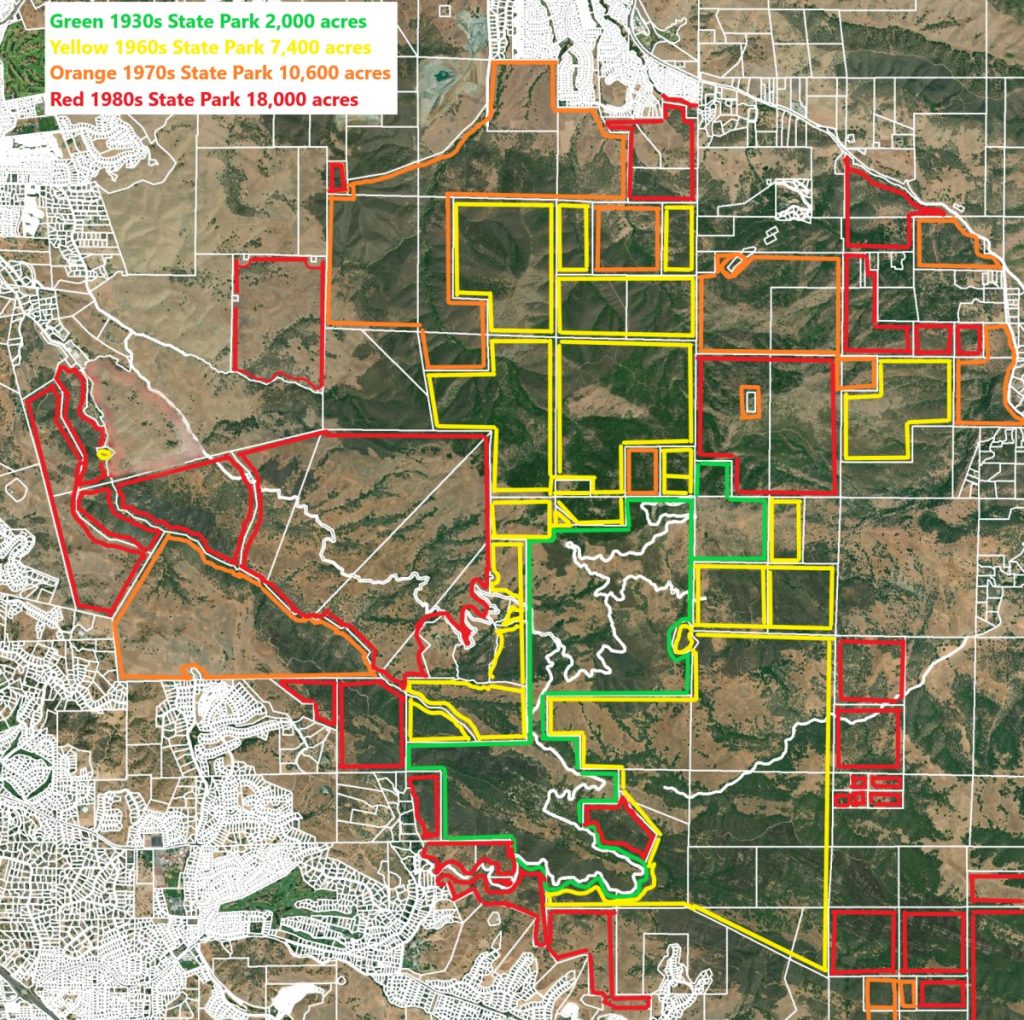
Mount Diablo is a park that evolved from 2,149 acres in 1960 to around 6,000 by the 1970s and close to 20,000 today. Park access also was also expanding from the original two paved roadway public access points and parts of the two “old stage road connectors in Pine Canyon and Dan Cook. Little else in the way of public access was available until the late 1970s when Macedo Ranch and Mitchell Canyon were added as official staging areas.
Early park users had to drive up into the park near the Junction, park their vehicle and then explore on foot, horse or bike off the paved surfaces. The entire park was changing and the user groups were evolving rapidly. Housing development was also destroying the horse stables all around the park making equestrian access more restrictive. And mountain biking was exploding into a full-blown sport.
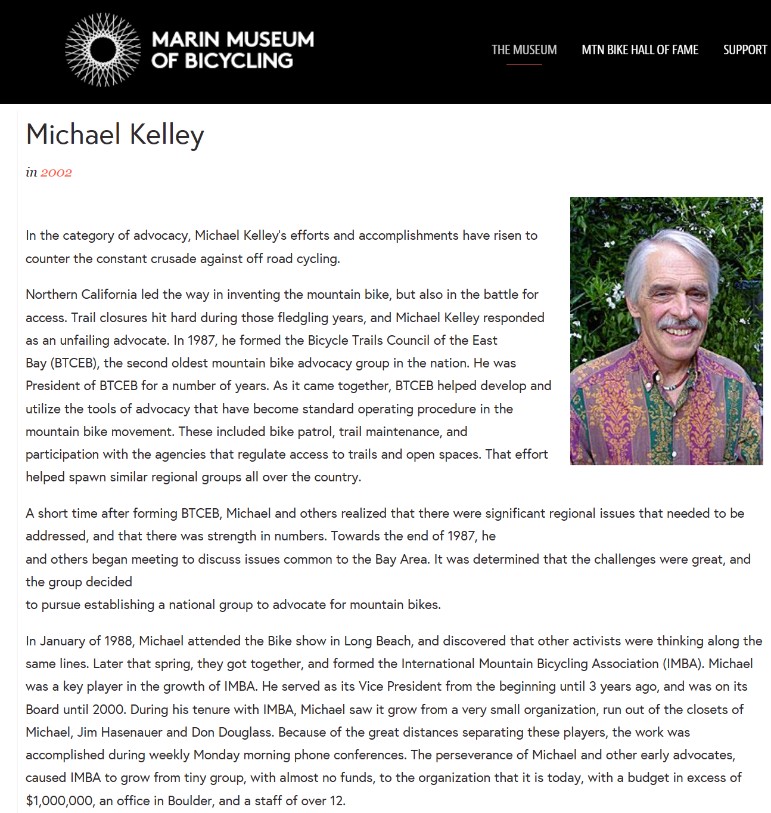
Enter Michael Kelley. I met Michael in 2021 when I was attempting to research the East Bay Area Trails Council and little did I know he would be such a resource. “You looking for old documents related to Mt. Diablo and Trails? Well, I have been meaning to do something with the boxes in my attic so have at it”
As it turns out Michael had 12 boxes of old newsletters and correspondence from those early 1980s days because not only had he been active in the East Bay Area Trails Council (EBATC) but he co-founded BTCEB and IMBA. He was da man, although they also called him the big muckity muck or the grand pooba.
Michael and his band of mountain biking advocates started BTCEB, encouraged other regional mountain biking groups to form and within a year co-founded the national/international organization IMBA International Mountain Biking Association.
Back to Mount Diablo Trails
The actual size of the park was expanding so rapidly and mountain bikers, who like equestrians could cover more ground than hikers, began to explore any ranch road or trail. There were many gates, private property areas or carveouts and riders routinely encountered locked gates. Confusion reigned.
The first thought by the State Park system was to just close State Parks to mountain bikes, period. In the spring of 1987 BTCEB newsletter reports……Currently Mount Diablo State Park is closed to off-road bicycling.
1988 Mount Diablo Advocacy Efforts
1988 was the inaugural year for mountain bike advocacy. First, it was necessary to recognize that mountain biking was a new user group exploding in size. At the March 1988 California State Recreational Trails Conference held in Asilomar, California trail advocates from all over the state and representing all user groups met to discuss statewide trails policy. Specifically addressed was the creation of a mountain biking policy for the State Park system.
BTCEB reports in their April 1988 Newsletter:

This was a great start and yet the devil was in the details. As reported in the Conference summary, all roads, service and fire, will be opened to mountain bikes, and all trails closed as of January 1, 1989 subject to specific changes as determined by the District Supervisors and the Regional Directors. The State Parks recognized that each park was unique and Park Rangers should have some control over this blanket “roads open, trails closed” solution. Below is a summary from the California State Recreational Trails Conference:
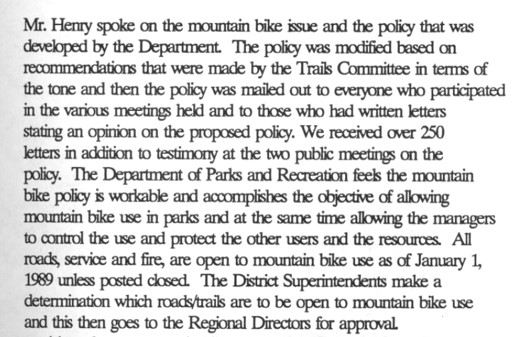
Think about this for a moment. In 1988 all fire roads and trails within Mount Diablo were closed to mountain bikes. But in 1989 roads would be opened unless posted closed. Trails would remain closed unless posted open. The degree to which trails would be opened depended upon the comfort level of the Park Rangers, signed off by the District Supervisor. Each Park determining its own exceptions.
Michael and his crew at BTCEB sprung into action to advocate for specific trails for mountain bikers. In March 1988, BTCEB was able to get three special permits to survey Mount Diablo trails for potential mountain bike use. They would then report to the Park Superintendent by the end of the month.
On May 6th Michael Kelley, Michael DePew and Barry Tyler joined Ranger Tom Bernardo on a tour of fire roads in the park. Any opening or closing of trails would require signage and BTCEB volunteered. They specifically discussed a trail signage plan to be installed by BTCEB at an upcoming Trail Day (basically volunteer efforts to improve trails and such)
By July discussions expanded to the creation of an informational brochure/map for Diablo mountain bikers.
Greg Gardiner, an early mountain biker and active BTCEB member recalls the extensive work the organization did to help open these trails, including trail work, trail inspections, signage, and ranger walk abouts. After the trial periods of mountain bike use, an inspection was conducted with Felix Arteaga (the Park Superintendent) and the only trail damage he saw was from horses and it was minor. There were also no incidents with bikes so the advocacy paid off and the trails were officially slated to open.
Greg also recalls the extensive Trail Days where the BTCEB members worked on Dan Cook and Buckeye, and as he states, reclaimed Oyster Point from the rattle snakes and poison oak.
To keep the trails open BTCEB was required to establish a Bike Patrol, work with the rangers on educating riders, be trained in emergency first aid, help educate equestrians and bikers in co-existence all while documenting volunteer hours, wearing bike patrol jerseys, occasionally carrying radios and meeting with the rangers on a regular basis to keep up the significant presence. Oh, and to install waterproof boxes at every trailhead with BTCEB pamphlets detailing trail etiquette, open trails, and to install three-way yield signs.
By August the State Parks announced two public hearings on mountain bike trail use, one in September in Southern California and one in October in San Francisco. More broad public input was requested and received.
In the September 1988 Newsletter, Michael’s positive spin and hopeful outcomes are reflected in what is still a disappointing result so far:
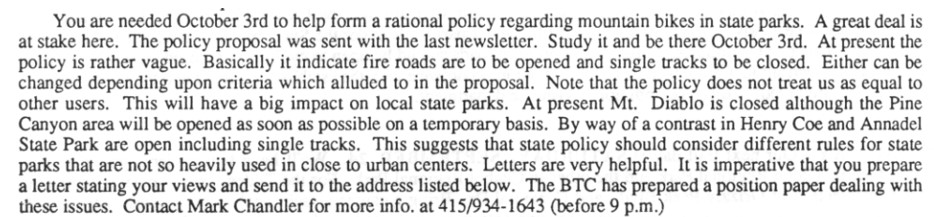
Note the frustrating status of Mount Diablo. “At present Mount Diablo is closed although the Pine Canyon area will be opened as soon as possible on a temporary basis.” Looking back on this today it is almost laughable that an old stage road built in 1874 could be closed to mountain bikers. But the issue was private property rights and connectivity. Some of the original stage road was still in private hands.
By December 1988 Michael reports the following:
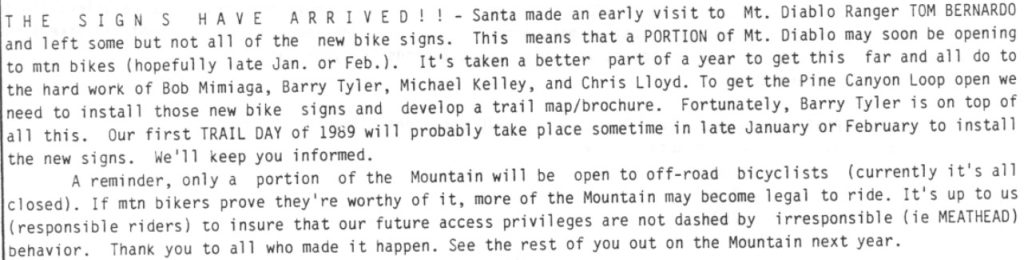
I hope readers see the amount of effort that went into these early years. Momentum was building for mountain biker access rights
And sure enough as the State promised, on December 13 1988 Departmental Notice 88-65 was released to be effective Jan 1 1989 and says
Generally, paved and unpaved park roads, unless otherwise posted, are open and trails closed to bicycles.
Unpaved roads may be closed and trails opened upon a written order by the District Superintendent, approved by the Regional Director.
This policy will take effect immediately for paved and unpaved roads and for trails 9 months from the date of adoption. (So only a 9-month delay in what had already been a year-long process. This is to allow time to review and in this interim period, the District Supervisor may open or close trails based on a posted order. Signed Director Henry R. Agonia
Well that is clear as mud. So basically it is a free for all for every State Park. Those user groups that speak the loudest and lobby the hardest could force closure of previously opened fire roads or force opening of previously closed trails. Equestrians and hikers and bikers start your engines and begin your campaigns.
But wait, it gets even crazier. Remember that individual Park Rangers could open or close fire roads or trails based on their respective views? Check out this District Superintendent’s Order from the very same Jan 1, 1989 date and signed by Superintendent Felix L. Arteaga regarding Mount Diablo State Park policy. Here we see that all roads and trails are hereby closed to mountain bikers with limited exceptions.
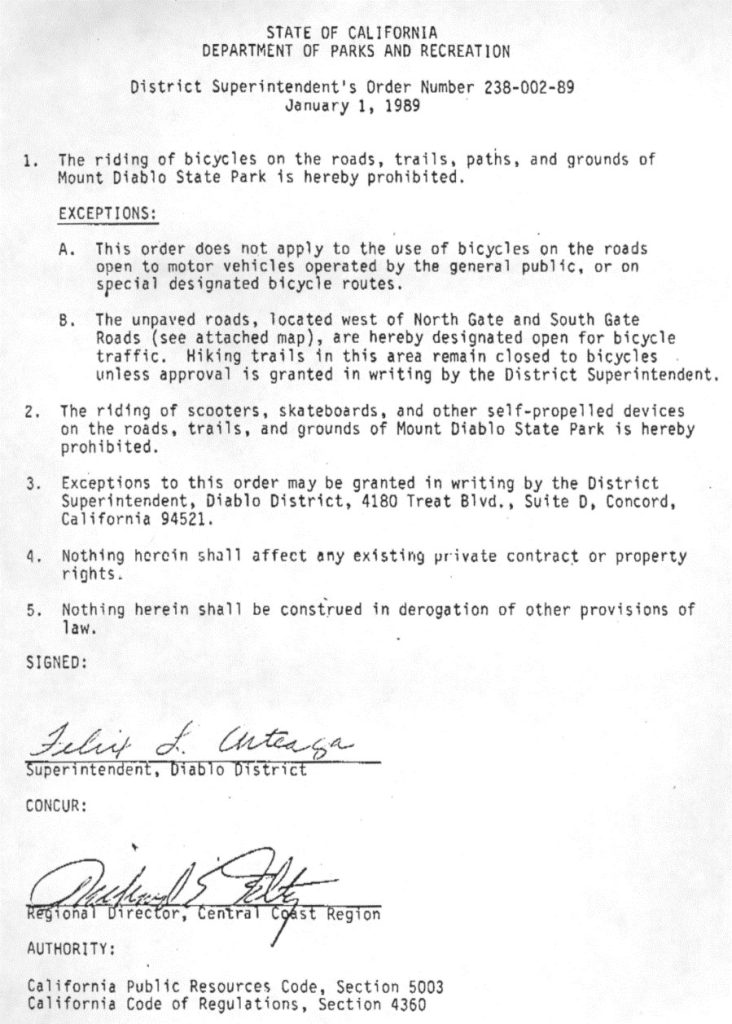
So what gives? What exactly is the policy or did Felix just ban mountain bikes from most of Mount Diablo State Park against the broader State Park policy agreed upon at the same date. Felix seemed to open only fire roads West of Northgate and Southgate Roads and close the rest of the park to mountain bikers.
Imagine the frustration of early mountain bikers. Especially those that took it upon themselves to “get involved” and to work toward practical solutions, like the BTCEB’s 200 members.
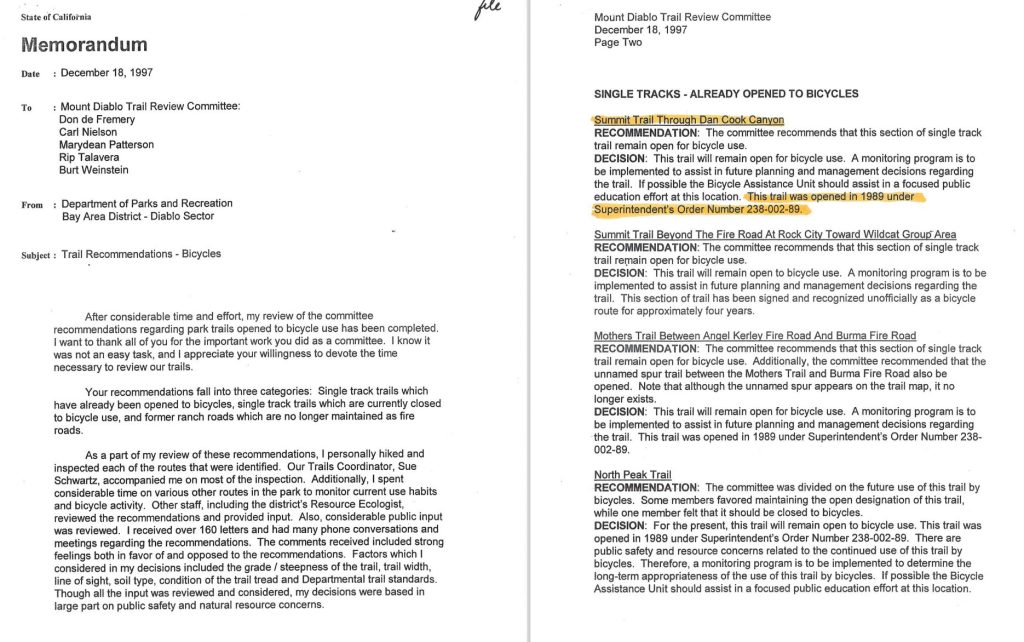
Well Michael and the team at BTCEB divided and conquered. They continued to work within the system, essentially desensitizing everyone to mountain bikes. They were a positive force for trails and signage and monitoring and finally they created a breakthrough. By the fall of 1989 Felix Arteaga decided to allow bikes on all fire roads within the park and as icing on the cake agreed to open three single tracks, the Dan Cook connector (upper bridge loop trail), Mothers Trail, and North Peak trail.
This was a big deal. Proof that advocacy works, proof that working within a complicated multi-voice adversarial system could yield positive results and proof that a group of motivated individuals could make a difference.
Dan Cook Connector, officially opened to mountain bikers in 1989
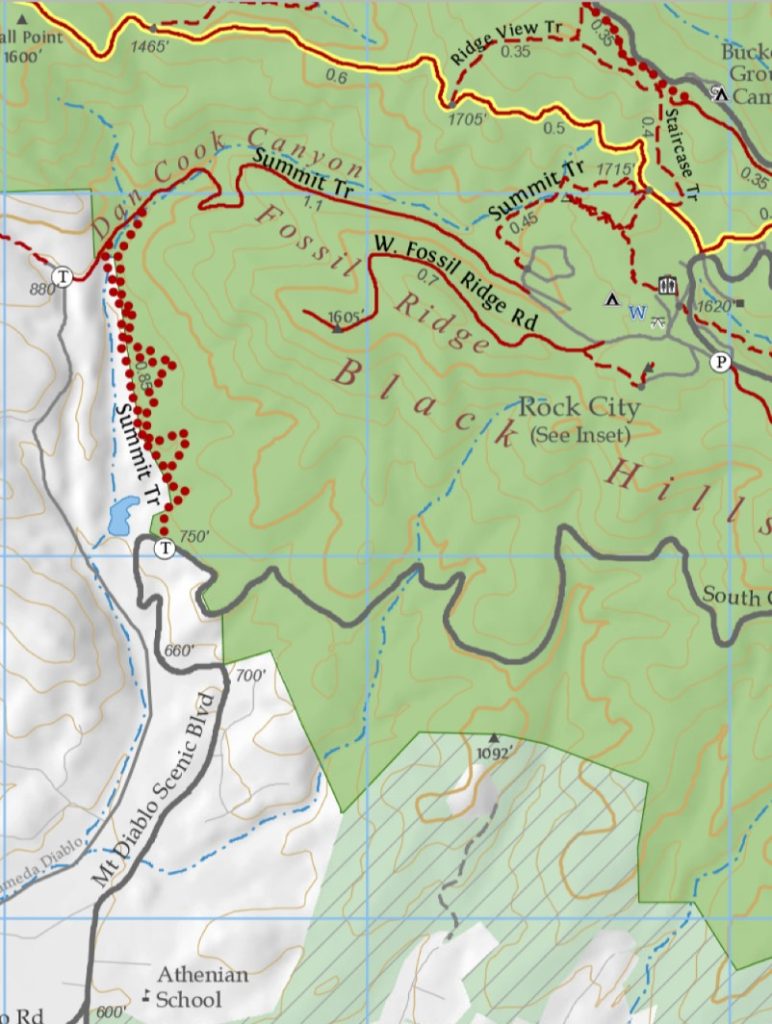
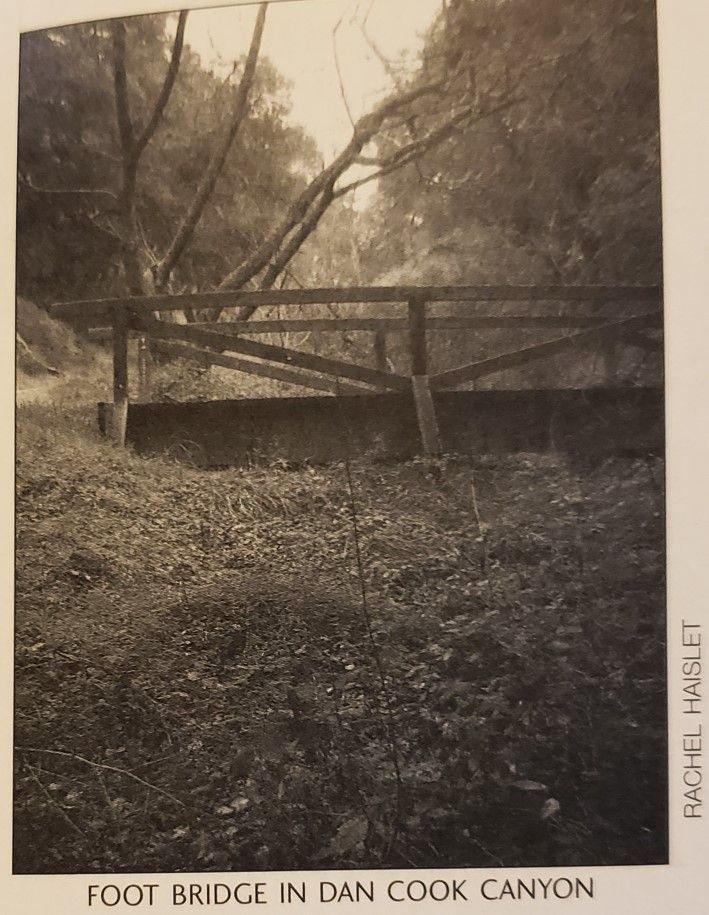
This trail was actually a new trail built and completed in the late 1980s running parallel to the original 1959 easement, now called the lower bridge loop crossing an old steel and wooden bridge (still in use today). The new, bike legal Dan Cook connector became the upper bridge loop and it required tread work, clearing and a new wooden bridge across the wide drainage at the Dan Cook Canyon fire road itself. Why did the State Park build a new trail essentially parallel to the old 1959 easement (shown on the left below)? (Both trails are shown as red dots below on the right on the Save Mt. Diablo Map, also labelled Summit Trail).
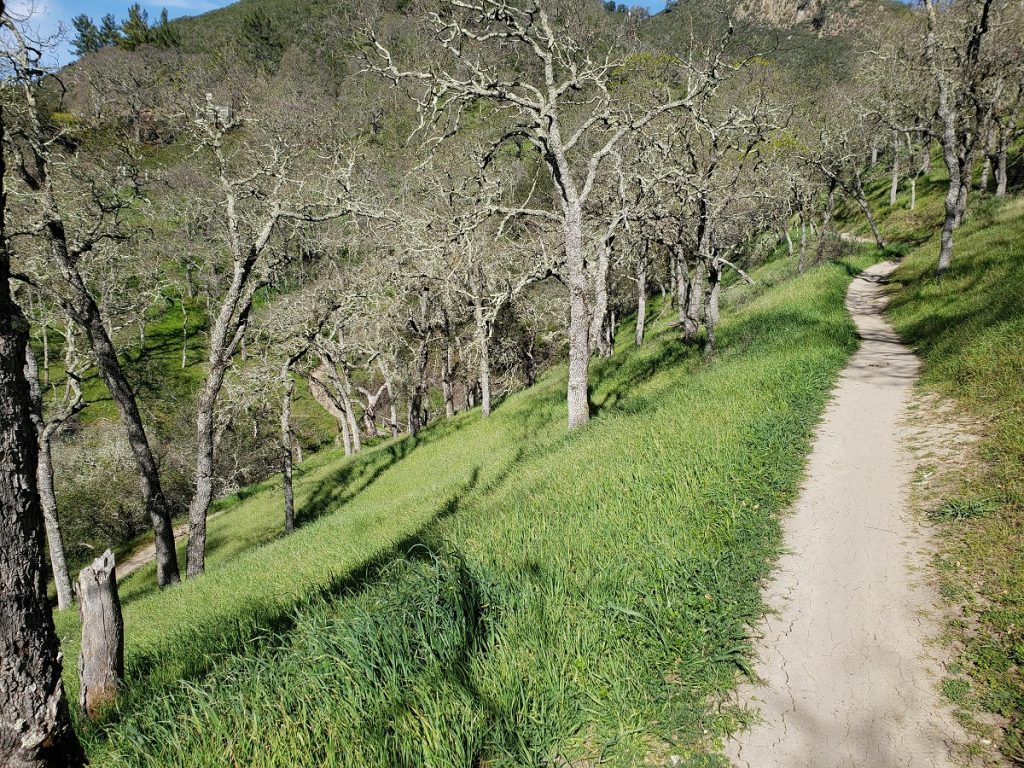
First, the State Park was concerned that the original 1959 trail was difficult to maintain had too many ruts and steep sections and was too close to 4 or 5 different Diablo parcels, maybe even encroaching on those parcels in places. Rather than have homeowners threaten to fence off the trail (this area was subdivided in the 1970s), the State approved the building of this new trail that has controlled grades and sweeping turns and is a joy to use. This upper bridge loop (now called Summit Trail) has become one of the most popular single-track trails in the State Park. It offers mountain bikers or gravel bikers the most accessible way up the mountain.
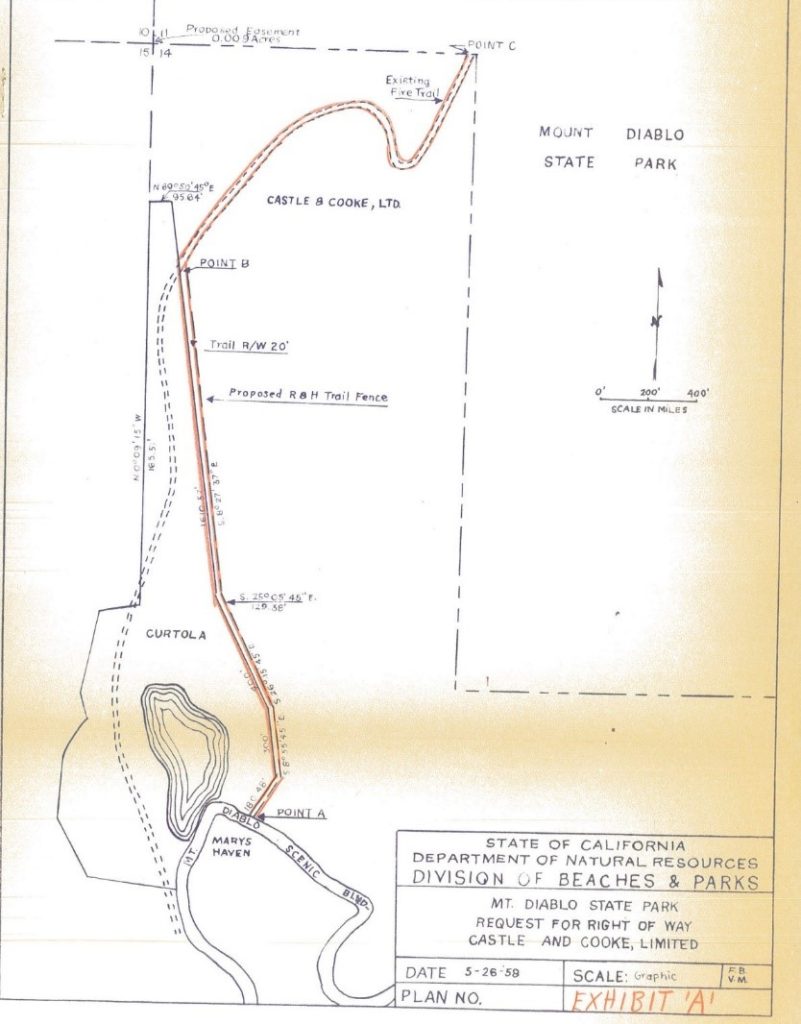
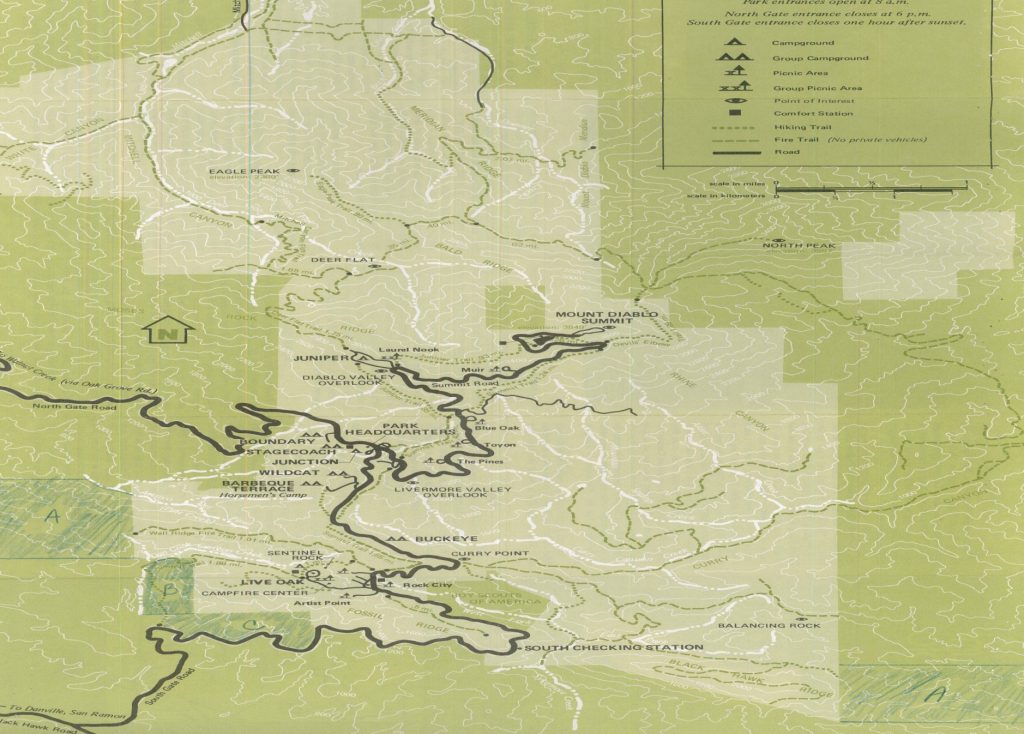
Think about the craziness of the State Park back in the late 1970s into early 1980s. Development activity all around the park unlocked large parcels of land that were given to the State as mitigation. State Funds, when available also purchased parcels and Blackhawk development being so large was key to some very important State Park additions in and around Diablo. The map below shows four critical 1980 additions to Mount Diablo State Park from Blackhawk. Shaded parcel A areas, far left (much of Wall Point) and far right (Oyster Point), as well as Parcels B and C (extending the park boundary to the Diablo Lake and the original kiosk location and Park Road Entrance. Previous to this acquisition the only way to get from the road to Dan Cook was by using the 1959 lower bridge loop easement across private Blackhawk property.
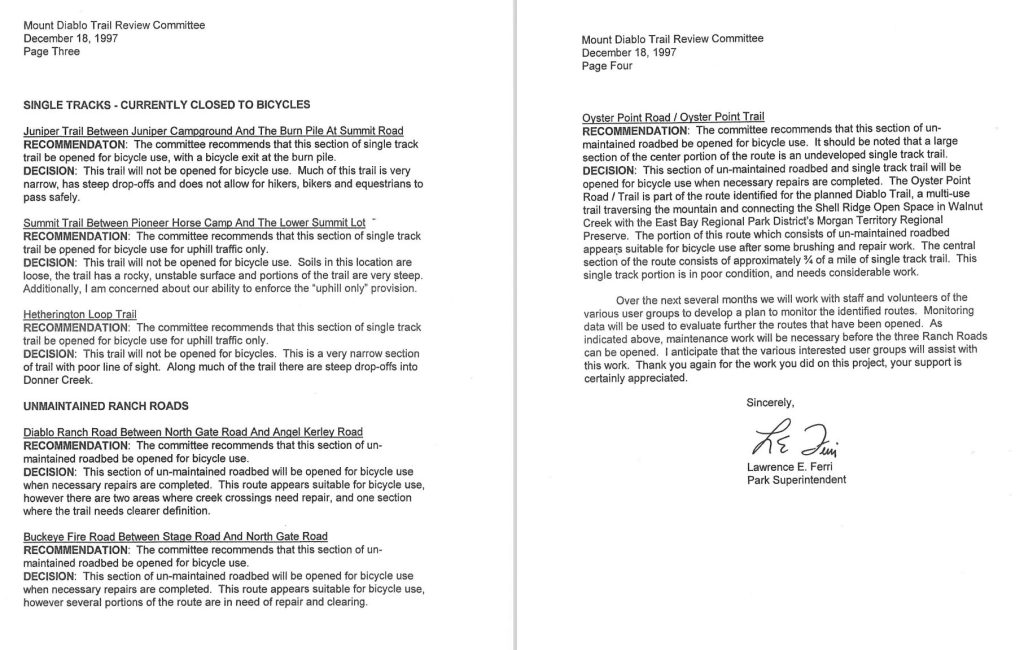
Understanding full well that it takes time to integrate new lands, it was not until March 1998, a full 9 years later that BTCEB reported that Oyster Point trail was slated to open, pending some trail work. And two former ranch roads, Diablo Ranch Road and Buckeye Road would become bike legal. All three were deemed by the State to be unmaintained old ranch roads and with some effort could be cleared enough to become safe single-track routes for mountain bikes.
The Mount Diablo Trail Review Committee memo shown below from December 1997 is the most complete record we have of mountain bike advocacy successes and timing.
Mountain Biking as a User Group
According to a feature article in Bicycling in Oct/Nov 1989 by Scott Martin: Since its introduction in 1979, the sport has grown from a regional fad into a nationwide fascination, and the cycling world with never be the same….” By last year (1988) there were an estimated 7.5 million mountain bike users in the US up from 200,000 in 1983. (BTCEB Nov 1989 newsletter).
Think about the freedom afforded by a mountain bike. A user could cover significantly more ground than a hiker, more like an equestrian but limited only by the user’s pedal power. A mountain bike is harder on a trail than a hiker but significantly less damaging to a trail than a horse. The addition of this fast-growing user group was clearly a disruptive event but well within the scope of previous use and trail demands.
Think also about how long it took for proper connections to be available. The State Park needed to expand to almost 20,000 acres to properly accommodate the number of trail connectors that we take for granted today.
Pine Canyon is open from Castle Rock past Pine Pond and either up to Diablo Ranch or up BBQ Terrace.
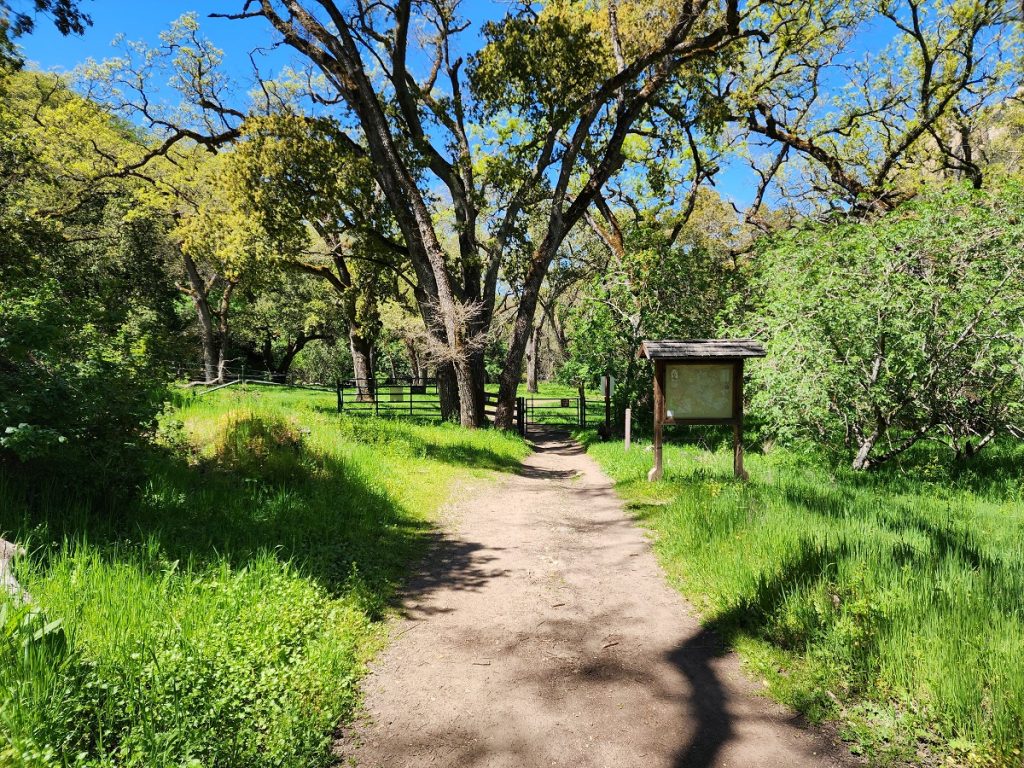
This was a hodge podge of State and Private with locked gates and unclear access until the 1980s. EBRPD opened Pine Canyon to the picnic table area at the State Park gate in the late 1980s but only to that point. Past the gate was a State Park access issue that took longer to resolve.
Lower Wall Point and Dusty Trail were part of Macedo Ranch, as was the middle section of Pine Canyon past the picnic table area at the bottom of Little Yosemite until this 787-acre parcel was purchased, not from Frank Macedo but from a developer in the late 1970s. Yes, until then there was still pressure build houses on this property. This Macedo purchase then opened up the long connection from Shell Ridge to Diablo Foothills to Mount Diablo all part of the Briones to Mount Diablo Regional Trail.
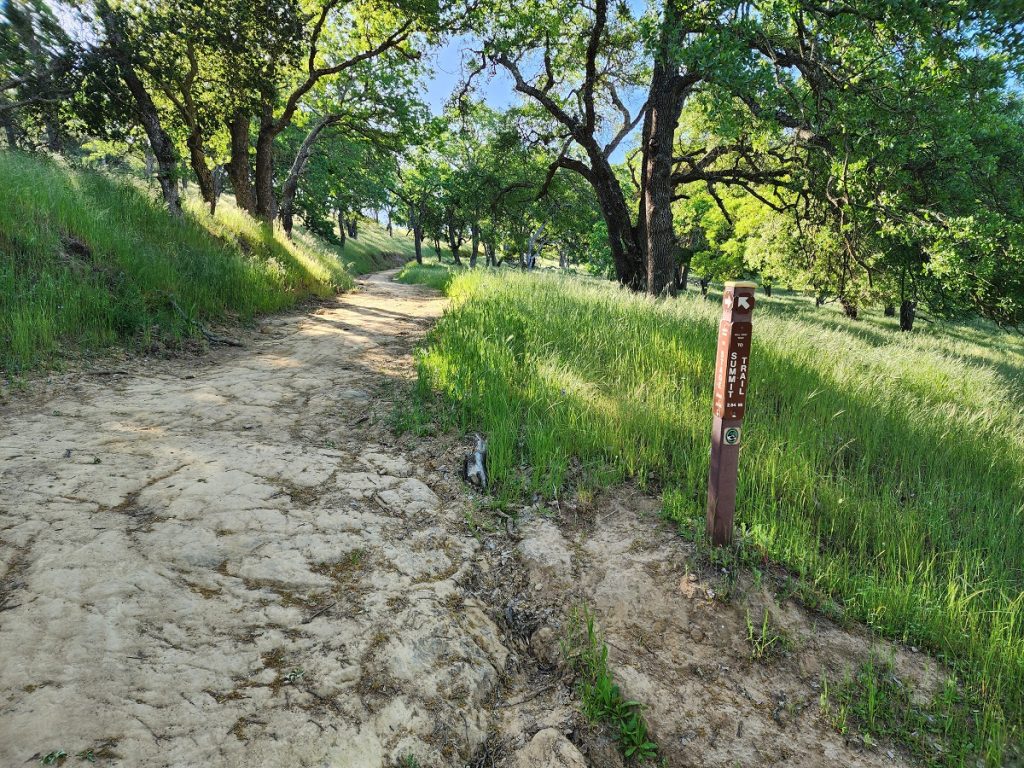
Macedo Ranch Staging area was opened around 1980. Mitchell Canyon Staging area was opened around 1980 and suddenly Mount Diablo had non-paved points of access made for equestrians and mountain bikers and hikers.
Think about how far we have come in access rights and trails. It has required people like Michael Kelley and the early mountain bikers to get us to where we are today. Moving forward will require partnerships between user groups and park officials.
Properly maintained trails are a public benefit that will still be in use 100 years from now. Preserving creeks and ridgelines is a noble cause and a public benefit in its own right. But proper loop trails and connectors offer users a way to touch and feel the protected lands. Proper loop trails also protect the environment by keeping the public use contained and leaving the surrounding areas as natural as possible.
Let me close with these State Park user signs representing the main challenge the mountain biking community today, one of ghosting.
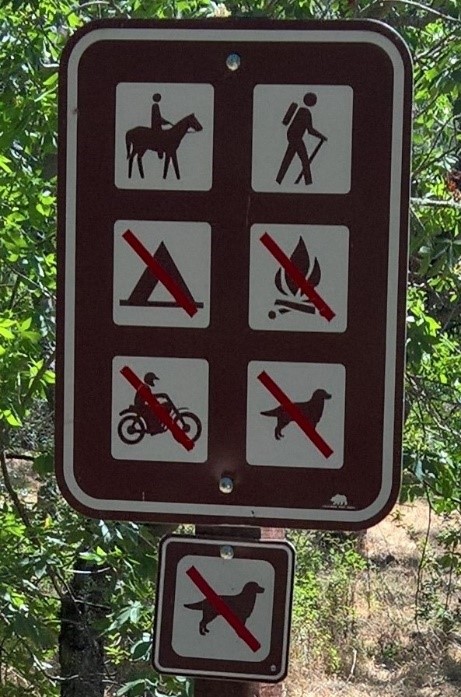
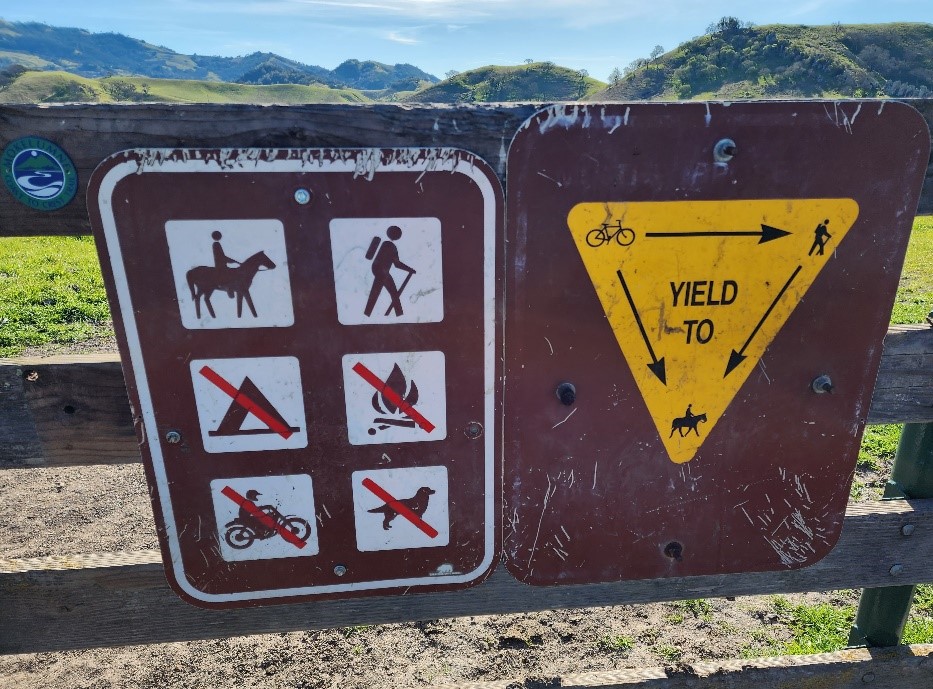
The left sign is found in Pine Canyon at the State Park entrance gate just beyond the picnic tables at the bottom of Little Yosemite. The right sign is at the State Park gate from Diablo Foothills. Both are wide fire roads and yet there are no icons for bikes, period. For or against. Almost as if by pretending they are not a user group, they will go away. (The yellow yield sign was installed by the BTCEB group as part of their efforts to open fire roads to bikes.)
Mountain bikers are the second largest user group on fire roads and trails in any and all open spaces. Yet even today they are almost ignored or dismissed by agency employees and other user groups. As if ignoring them will make them invisible.
Bike advocacy groups need to remember their roots and revisit some of the efforts made by Michael and his band of early riders. Extra effort is required. Volunteer to work on trails, engage other user groups in a friendly manner, and continue to be good stewards of the amazing trail system we have available to us.
Sept 1997 Memorandum Single Track